
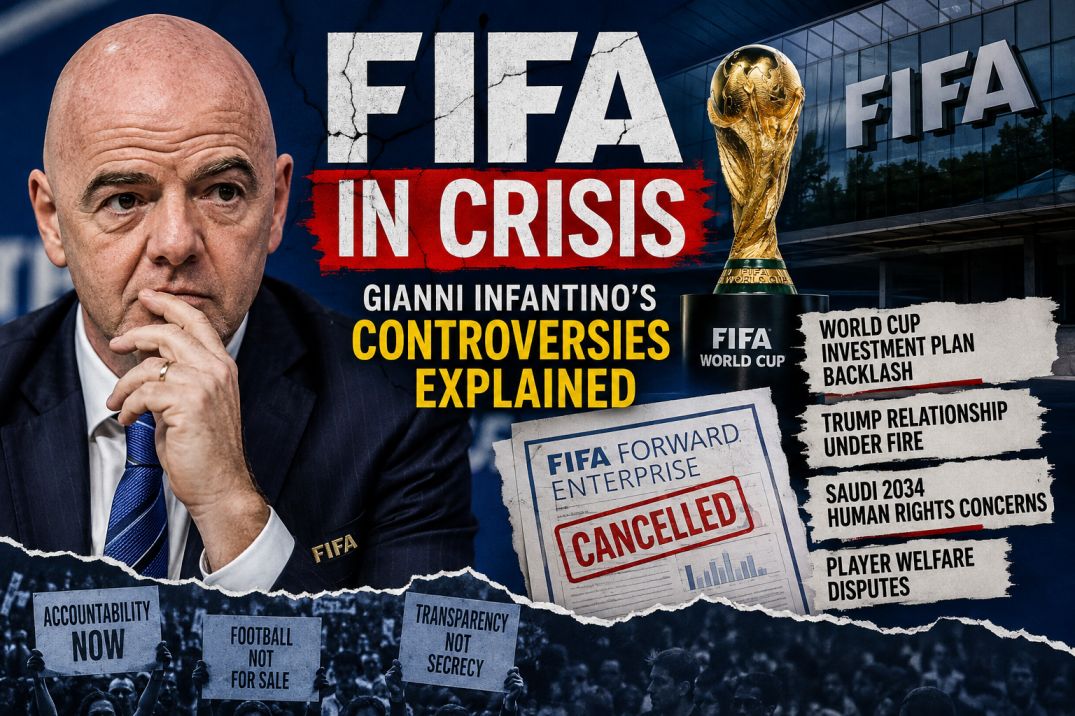
FIFA president Gianni Infantino is facing the most serious leadership crisis of his decade in charge of world football after being forced to abandon a controversial proposal involving private investment in the organisation’s most valuable competitions.
The immediate dispute concerns FIFA Forward Enterprise, a planned commercial subsidiary that would have managed important revenue-generating activities connected to the World Cup and other FIFA tournaments.
FIFA proposed selling minority interests of up to 20% in the company to external investors, with the organisation aiming to raise as much as $4.2 billion based on a reported enterprise valuation of $20 billion. Infantino argued that the arrangement could produce unprecedented development funding for FIFA’s 211 member associations.
However, UEFA, Concacaf and other football authorities objected to the proposed ownership structure and, more importantly, the process through which it had been developed.
UEFA said it had lost confidence in the current FIFA leadership. Concacaf accused FIFA of advancing a plan affecting the future of the World Cup without sufficient transparency, consultation or due process. The opposition became so intense that FIFA withdrew the proposal only days after presenting it publicly.
The failed plan has reopened questions about Infantino’s leadership style, political relationships, approach to human rights, expansion of FIFA competitions and treatment of players and other football stakeholders.
It has also placed new uncertainty around the FIFA presidential election scheduled for March 2027.
Why Is FIFA in Crisis?
FIFA is not facing one single criminal case or corruption conviction against its president.
The current crisis is primarily agovernance and confidence crisis.
A rare coalition of regional confederations, national associations, football officials, politicians and other stakeholders concluded that a major change to the commercial structure of world football had progressed too far without adequate scrutiny.
Concacaf said its members had concerns about:
- The absence of established due process
- A short decision-making timetable
- Insufficient consultation
- A lack of review by relevant FIFA governance bodies
- The proposed use of private investment despite FIFA’s substantial financial reserves
Its 41 member associations rejected the proposal and instructed their representatives to demand that future decisions follow FIFA’s formal governance procedures.
Reuters reported that UEFA’s 55 associations unanimously opposed the initiative and threatened to boycott FIFA events until it was withdrawn. The protest was particularly damaging because successful FIFA tournaments depend heavily on the participation of Europe’s leading national teams and players.
The proposal was scrapped, but the dispute did not end there.
UEFA said withdrawing the plan was only the beginning of the process of rebuilding trust. Concacaf went further, describing the episode as evidence of a wider pattern of poor governance and calling for a comprehensive examination of Infantino’s presidency.
What Was FIFA Forward Enterprise?
FIFA Forward Enterprise, commonly shortened to FFE, was intended to bring FIFA’s tournament operations and commercial activities into a new subsidiary.
Those activities would have included areas such as:
- Broadcast rights
- Sponsorship
- Ticketing
- Licensing
- Commercial management
- Operational delivery of FIFA tournaments
FIFA said it would permanently own and control the proposed company. External investors would hold minority, non-controlling interests, while FIFA would retain authority over football governance, competition formats and sporting decisions.
Under the proposal, every member association would have been eligible to receive $20 million through the FIFA Forward development programme for the 2027–2030 period. FIFA also proposed a separate voluntary one-off allocation of another $20 million per association through a Fast Forward programme funded by external investment.
FIFA’s argument was that private capital could unlock the commercial value of its competitions and provide more money for:
- Grassroots football
- Training facilities
- Women’s football
- Youth development
- National teams
- Coaching programmes
- Football infrastructure
This aspect of the plan explains why Infantino may continue to receive support from associations that depend heavily on FIFA funding.
The dispute was therefore not simply about whether football development should receive more money. It concerned who would control the commercial structure, what investors might expect in return and whether the plan had undergone sufficient independent examination.
Why Did Football Authorities Reject the Plan?
Critics raised three main concerns.
1. The World Cup could become exposed to private-investor interests
The World Cup is FIFA’s most important commercial property and one of the most valuable sporting events in the world.
Critics feared that outside investors seeking long-term returns could eventually influence decisions relating to tournament size, frequency, sponsorship, ticket prices or the wider international calendar—even if FIFA retained formal control.
FIFA responded that no sporting or regulatory authority would be transferred and insisted that “nobody is selling football.” It also said the proposal could not proceed without support from a majority of member associations and the relevant FIFA Council approvals.
Opponents were unconvinced. Their concern was not limited to legal control; it included the commercial pressure that minority investment could create around FIFA’s competitions.
2. Major stakeholders said they were not consulted
Concacaf said it initially learned about the proposal through media reports. It later complained that the project had not been reviewed or approved through the expected FIFA governance processes.
Reuters reported that several senior football officials and confederations had been unaware of the plan before details emerged publicly.
The apparent lack of prior consultation became as damaging as the financial proposal itself. It reinforced an existing perception among critics that major FIFA decisions can be developed by a small leadership group and then presented to members with limited time for scrutiny.
3. Critics questioned why FIFA needed private capital
FIFA had just completed what it described as an exceptionally successful and lucrative 2026 World Cup cycle.
UEFA pointed to FIFA reserves of more than $5 billion and questioned why existing funds could not be used to increase development payments without selling interests in a new commercial operation.
Concacaf similarly instructed its FIFA Council members to explore how existing reserves could be distributed through the established FIFA Forward programme.
The argument was that FIFA could support smaller associations without creating a structure that exposed World Cup-related revenue to outside investors.
Did FIFA Sell the World Cup?
No.
The FIFA Forward Enterprise proposal was withdrawn before the proposed transaction was completed.
No 20% stake in the World Cup or the proposed subsidiary was ultimately sold.
FIFA initially defended the plan and said it was only the starting point of a consultation. Infantino later abandoned it after opposition from regional confederations, member associations and other stakeholders made the proposal politically unsustainable.
The controversy remains important because it revealed a major breakdown of trust between FIFA’s president and influential parts of the football structure.
Why Infantino’s Relationship With Donald Trump Is Controversial?
Infantino’s close relationship with United States President Donald Trump has generated separate questions about FIFA’s requirement to remain politically neutral.
The relationship became particularly visible during preparations for and delivery of the 2026 World Cup in the United States, Canada and Mexico.
FIFA worked directly with a White House World Cup task force established by Trump’s administration. Cooperation between a sporting body and a host government is normal and necessary for security, visas, transport and tournament organisation. The controversy concerns whether Infantino’s conduct went beyond institutional cooperation and appeared to become personal political support.
The criticism intensified after FIFA created an inaugural Peace Prize and presented it to Trump during the World Cup draw in Washington in December 2025. FIFA said the award recognised Trump’s role in peace initiatives and diplomatic engagement.
Human-rights organisation FairSquare subsequently filed a complaint alleging that Infantino had repeatedly breached political-neutrality rules. Its complaint cited his public support for Trump and other interactions between the FIFA president and the US administration.
The International Olympic Committee declined to investigate the complaint, explaining that the allegations concerned FIFA governance and fell outside the jurisdiction of the IOC Ethics Commission. That decision didnot constitute a factual ruling that every allegation was false; it was a jurisdictional decision about which organisation had authority to examine the conduct.
What Happened in the Folarin Balogun Red-Card Dispute?
Political-neutrality concerns grew during the 2026 World Cup after Trump said he had contacted Infantino about a suspension given to United States striker Folarin Balogun.
Balogun was subsequently permitted to play after FIFA’s independent disciplinary process reconsidered the sanction.
There is no public evidence establishing that Infantino personally ordered the disciplinary body to change its decision. FIFA maintains that disciplinary decisions are handled by independent judicial bodies.
However, the sequence created damaging public optics: a head of government said he had contacted the FIFA president, and a decision benefiting the host nation was later changed.
FairSquare included the matter in its complaints and requested an investigation into whether political pressure had influenced football governance. Reuters reported that the episode strengthened perceptions that Trump could communicate directly with Infantino about a sporting disciplinary matter.
The controversy is therefore about independence and public confidence, not proof that Infantino personally overturned the red card.
The Joshua Kushner Connection
The collapsed FIFA Forward Enterprise plan attracted further scrutiny because an investment group associated with Joshua Kushner was expected to play an important role.
Joshua Kushner is the brother of Jared Kushner, Trump’s son-in-law and a prominent political adviser.
Reuters reported that FIFA had held investor discussions involving Joshua Kushner-founded Thrive Capital. Critics argued that the political connection made an already sensitive transaction look even more problematic given Infantino’s relationship with Trump.
The family relationship does not itself prove wrongdoing or establish that Trump influenced the proposed agreement.
Its significance lies in the potential conflict-of-interest perception: FIFA was considering a major commercial arrangement involving politically connected investors while its president was already facing questions about his closeness to the US administration.
Trump said he had not spoken with Infantino about the investment proposal.
Saudi Arabia and the 2034 World Cup
Another major criticism of Infantino’s FIFA concerns the decision to award the 2034 men’s World Cup to Saudi Arabia.
Saudi Arabia was appointed host by acclamation at an extraordinary FIFA Congress on December 11, 2024, after emerging as the only bidder. FIFA described the selection as the conclusion of a formal bidding process supported by its confederations.
Human-rights organisations argued that the process did not adequately address risks concerning:
- Migrant workers
- Wage protection
- Heat exposure
- Freedom of expression
- Women’s rights
- LGBTQ+ people
- Labour-union restrictions
- The country’s sponsorship-based employment system
Amnesty International urged FIFA to halt the process unless Saudi Arabia announced credible reforms. Human Rights Watch argued that the hosting documents did not sufficiently address existing labour abuses and the risks created by large-scale construction.
FIFA and Saudi organisers have maintained that the tournament can accelerate positive development and that human-rights commitments will form part of its delivery.
Critics nevertheless see the uncontested process as another example of FIFA moving quickly towards a commercially attractive outcome without creating sufficient competition or independent scrutiny.
Qatar 2022 and Infantino’s Controversial Speech
Infantino also faced widespread criticism before the 2022 World Cup in Qatar.
At a pre-tournament press conference, he strongly defended Qatar against Western criticism and attempted to express solidarity with groups that had experienced discrimination.
His remarks included statements that he felt gay, disabled and like a migrant worker. The comments were criticised as insensitive because Infantino had not personally experienced the legal discrimination, physical danger or working conditions faced by the groups he referenced.
The controversy became symbolic of FIFA’s response to questions concerning migrant-worker deaths, labour conditions and LGBTQ+ rights surrounding the tournament.
Supporters of Infantino argued that Qatar had faced disproportionate criticism and that FIFA helped produce some labour reforms. Critics believed his speech minimised legitimate human-rights concerns and centred the FIFA president rather than affected workers. Reuters identified the Qatar speech as one of the major controversies Infantino had previously survived before the 2026 governance revolt.
FIFA’s Expanding Calendar and Player-Welfare Dispute
Infantino has overseen major growth in FIFA’s tournament programme.
The men’s World Cup expanded from 32 to 48 teams, while the Club World Cup became a 32-team competition. More matches generate additional broadcast, sponsorship and ticketing revenue, but they also increase demands on players and clubs.
FIFPRO Europe and European Leagues filed a complaint with the European Commission challenging FIFA’s handling of the international match calendar. They alleged that FIFA imposed decisions without adequately consulting leagues and player representatives and that the governing body’s dual role as regulator and competition organiser created a conflict of interest.
Player unions also initiated legal action specifically challenging the creation and scheduling of the expanded Club World Cup.
FIFA has rejected claims that it disregards player welfare. It has pointed to measures including a proposed minimum of 72 hours between matches, a minimum post-season rest period and greater consideration of travel and climatic conditions. FIFA has also accused some player-union officials of refusing constructive engagement.
This dispute matters because the failed FFE proposal increased fears that private investment would create further pressure to add competitions, matches and commercial inventory.
Readers can review Score9ja’s explanation of the World Cup 2026 rule changes and explore the tournament’s structure through the FIFA World Cup fixtures and results hub.
World Cup Ticket Prices and Commercialisation
The pricing and commercial direction of FIFA tournaments have also attracted criticism.
Former FIFA vice-president Jim Boyce argued that the organisation must refocus on ordinary football supporters following the collapse of the private-investment proposal. He included high World Cup ticket prices among the issues that had weakened trust in FIFA’s leadership.
FIFA’s position is that higher commercial income allows it to organise global tournaments and redistribute substantial revenue to associations that could not generate comparable funds independently.
The tension is clear:
- FIFA wants to maximise the value of its global competitions.
- Member associations want larger development grants.
- Investors and sponsors expect commercial returns.
- Supporters want affordable access.
- Players and clubs want manageable schedules.
- Confederations want meaningful influence over decisions.
The FFE crisis emerged because critics believed the proposed balance had moved too far towards commercial extraction without enough consultation.
Score9ja readers can find more background in the guide to FIFA World Cup ticket prices and sales.
Was Infantino Found Guilty in Earlier Swiss Investigations?
No.
Infantino was previously investigated in Switzerland over undocumented meetings with former Swiss attorney general Michael Lauber while Lauber’s office was investigating football-related corruption.
The matter caused serious institutional concern, particularly because Lauber was responsible for overseeing sensitive FIFA investigations.
However, Swiss prosecutors closed the criminal proceedings against Infantino in 2023 without bringing charges. A separate investigation concerning a private flight taken in 2017 was also closed.
Those outcomes must be stated clearly.
It would be inaccurate to claim that Infantino was convicted or found criminally responsible in those cases.
The continuing controversy is instead that the undisclosed meetings contributed to questions about judgment, transparency and the relationship between FIFA leadership and authorities investigating football governance.
Has Gianni Infantino Resigned?
No.
Infantino remains FIFA president and has not announced his resignation.
He confirmed in April 2026 that he intends to stand for re-election in 2027. FIFA said he had received extensive support from member associations before the FFE controversy began.
The investment-plan dispute has nevertheless changed the political environment.
Reuters reported that Infantino’s re-election had previously appeared straightforward but could now attract credible rival candidates. UEFA and Concacaf represent 96 associations between them, although each national association casts its own vote at the FIFA Congress.
Infantino may still retain substantial support in Africa, Asia, South America and among smaller associations that credit FIFA Forward with improving infrastructure and football development.
That means pressure from UEFA alone does not automatically remove him.
What Happens Next at FIFA?
Five developments will determine whether the crisis becomes a permanent leadership change or another controversy Infantino survives.
Governance review
Confederations are demanding answers about who designed the FFE proposal, which officials approved its development and why standard consultation was allegedly bypassed.
UEFA has also reportedly warned of potential legal action and requested that documents connected to the failed plan be preserved.
FIFA Council pressure
The FIFA Council may demand changes to decision-making procedures or greater oversight of major commercial proposals.
Concacaf has said its Council members will use FIFA’s internal institutions to pursue questions of accountability and leadership.
Withdrawal of election endorsements
Some associations that previously supported Infantino may withdraw their endorsement before the 2027 election.
That would be politically damaging, although an endorsement withdrawal is not the same as a formal vote against him.
Emergence of a rival candidate
Infantino’s opponents need more than criticism. They need a candidate capable of attracting votes across Europe, Africa, Asia, the Americas and Oceania.
FIFA has 211 voting member associations, and each has one vote regardless of football strength or population.
A revised development-funding model
The strongest defence of Infantino’s proposal was its promise of substantially higher funding for national associations.
Any opposition movement will therefore need to explain how it would maintain or increase support for developing football nations without private investment.
This issue is particularly important for African associations. A governance reform campaign that appears designed only to protect European commercial interests may struggle to attract broad global support.
What the FIFA Crisis Means for African Football?
African associations have benefited significantly from FIFA Forward grants used for pitches, technical centres, youth competitions, women’s football and administration.
For African voters, the central question is therefore not simply whether Infantino’s leadership style is popular.
They must consider:
- Whether FIFA development funding has produced measurable local benefits
- Whether the proposed commercial structure created unacceptable long-term risks
- Whether promised payments could influence independent decision-making
- Whether a rival president would protect Africa’s funding and representation
- Whether FIFA’s governance system gives African associations a meaningful voice
Infantino has built strong relationships across Africa by presenting FIFA as a counterweight to the financial dominance of European football.
His critics will have to demonstrate that greater transparency and stronger governance would improve—not reduce—the resources reaching countries such as Nigeria.
Is FIFA Really Facing Collapse?
No.
FIFA remains financially powerful, continues to organise global competitions and retains authority over the international game.
The word “crisis” refers to Infantino’s loss of confidence among important stakeholders and the unusual scale of the revolt against his leadership.
The organisation itself is not about to disappear.
A more accurate assessment is that FIFA faces:
- A leadership crisis
- A governance crisis
- A trust crisis
- A dispute over commercial control
- A possible contested presidential election
The long-term outcome will depend on whether FIFA introduces credible oversight reforms and whether Infantino can rebuild support before the 2027 Congress.