
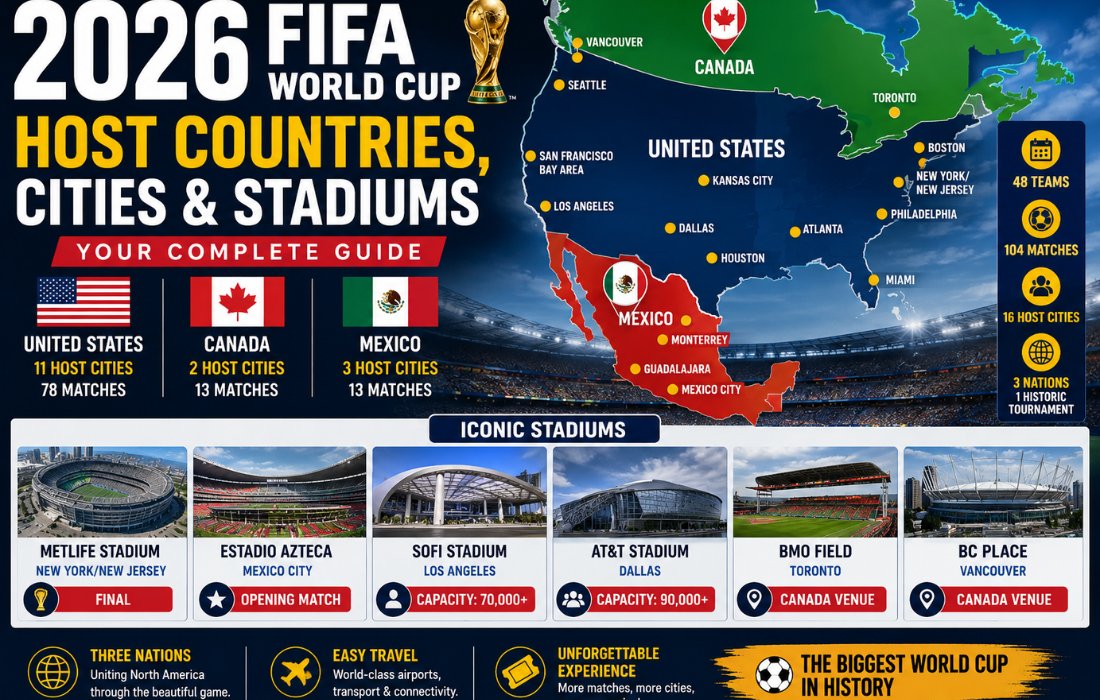
The FIFA World Cup 2026 will be unlike any previous edition of football’s biggest tournament.
For the first time in history, the competition will be hosted by three countries and will feature 48 national teams, expanding from the traditional 32-team format. The tournament will take place across the United States, Canada, and Mexico, bringing the World Cup back to North America for the first time since 1994.
With 104 matches scheduled across 16 host cities and some of the world’s most iconic stadiums, World Cup 2026 is expected to become the largest sporting event ever organized.
Whether you are planning to attend matches, buy tickets, travel between host cities, or simply want to understand where the tournament will be played, this guide covers everything football fans need to know.
Who Is Hosting the FIFA World Cup 2026?
The FIFA World Cup 2026 will be jointly hosted by:
- United States
- Canada
- Mexico
The joint bid, officially known as the United 2026 Bid, was selected by FIFA in June 2018.
The proposal received overwhelming support from FIFA member associations and defeated Morocco’s competing bid.
The tournament marks several historic milestones:
- First World Cup hosted by three nations
- First 48-team FIFA World Cup
- Largest World Cup in history
- First World Cup hosted across three countries
For football fans, this means more matches, more host cities, and a wider variety of stadium experiences than any previous tournament.
Why Three Countries Were Chosen to Host World Cup 2026
FIFA’s decision was influenced by several factors.
Existing Stadium Infrastructure
Unlike many previous World Cups, the host nations already possess numerous world-class stadiums capable of accommodating large crowds.
Many venues regularly host:
- NFL games
- MLS matches
- International football fixtures
- Major concerts
- Global sporting events
This significantly reduces construction costs and logistical challenges.
Travel and Accommodation Capacity
The United States, Canada, and Mexico collectively offer:
- Hundreds of international airports
- Extensive hotel capacity
- Modern transportation networks
- Established tourism infrastructure
These factors make it easier to welcome millions of visitors during the tournament.
Growing Football Popularity
Football continues to grow rapidly throughout North America.
The success of Major League Soccer, increasing attendance figures, and rising interest in international football contributed to FIFA’s confidence in the region’s ability to host the tournament.
2026 World Cup Host Countries at a Glance
| Country | Host Cities | Matches |
| United States | 11 | 78 |
| Canada | 2 | 13 |
| Mexico | 3 | 13 |
The United States will host the majority of matches, including the World Cup Final.
Mexico and Canada will each stage 13 matches.
All 16 Host Cities for FIFA World Cup 2026
Host Cities in the United States
The United States will host matches in:
- New York/New Jersey
- Los Angeles
- Dallas
- Houston
- Atlanta
- Seattle
- San Francisco Bay Area
- Boston
- Philadelphia
- Miami
- Kansas City
These cities represent some of the largest sporting markets in North America and feature stadiums capable of hosting crowds exceeding 60,000 spectators.
Host Cities in Canada
Canada will host matches in:
- Toronto
- Vancouver
Both cities have extensive experience hosting international sporting events and are expected to attract supporters from across the world.
Host Cities in Mexico
Mexico’s host cities include:
- Mexico City
- Guadalajara
- Monterrey
Mexico will become the first nation in history to host World Cup matches across three different tournaments after previously hosting in 1970 and 1986.
2026 World Cup Stadiums and Venues
The tournament will feature some of the largest and most technologically advanced stadiums in world football.
MetLife Stadium (New York/New Jersey)
Capacity: Approximately 82,500
MetLife Stadium has been selected to host the FIFA World Cup 2026 Final.
Located near New York City, it is expected to become the center of global football attention on the final day of the tournament.
Estadio Azteca (Mexico City)
Capacity: Approximately 87,500
Estadio Azteca is one of football’s most historic venues.
It hosted the World Cup Finals of both 1970 and 1986 and will become the first stadium in history to host matches across three different FIFA World Cups.
Legends such as Pelé and Diego Maradona have created unforgettable moments at this venue.
AT&T Stadium (Dallas)
Capacity: More than 90,000
AT&T Stadium is among the largest venues in the tournament and is expected to host several high-profile knockout matches.
Its retractable roof and modern facilities make it one of the premier sporting venues in the world.
SoFi Stadium (Los Angeles)
Capacity: Approximately 70,000+
One of the newest stadiums in North America, SoFi Stadium is renowned for its cutting-edge design and immersive fan experience.
BC Place (Vancouver)
Capacity: Approximately 54,000
BC Place will serve as one of Canada’s primary venues and is expected to host several important group-stage and knockout fixtures.
BMO Field (Toronto)
Capacity: Expanded for World Cup use
Toronto will host Canada’s opening World Cup match and is expected to become one of the most vibrant football destinations during the tournament.
Which City Will Host the World Cup Final?
The FIFA World Cup 2026 Final will be played at MetLife Stadium in New York/New Jersey.
This venue was selected because of:
- Large seating capacity
- International accessibility
- Global media infrastructure
- Proximity to New York City
The stadium is expected to welcome more than 80,000 spectators for football’s biggest match.
Where Will the Opening Match Be Played?
Mexico City will host the opening match of the tournament.
This decision continues Mexico’s rich World Cup tradition and ensures one of football’s most iconic cities launches the competition.
The atmosphere at Estadio Azteca is expected to be among the most memorable moments of the entire tournament.
How Many Matches Will Each Host Country Stage?
The expanded tournament format creates a larger distribution of matches.
United States
- 78 matches
- Most knockout-stage fixtures
- World Cup Final
Canada
- 13 matches
- Group stage and knockout rounds
Mexico
- 13 matches
- Opening match
- Group stage and knockout rounds
Travel Between World Cup Host Cities
One of the biggest challenges for fans will be the geographical size of the tournament.
Unlike previous World Cups hosted within a single country, World Cup 2026 spans an entire continent.
Travel in the United States
Many host cities are separated by thousands of kilometres.
Domestic flights will often be the most practical transportation option.
Travel in Canada
Toronto and Vancouver are located on opposite sides of the country, requiring significant travel planning.
Travel in Mexico
Mexico’s host cities are comparatively closer together and offer domestic flight connections and modern transportation options.
Travel Tip for Fans
Many supporters may find it easier and more affordable to choose one region rather than attempting to follow matches across all three countries.
Weather and Climate Across Host Cities
Weather conditions will vary significantly.
Fans could experience:
- Hot summer temperatures in Texas and Mexico
- Humid conditions in Miami
- Cooler evenings in Vancouver
- Moderate temperatures in Seattle and San Francisco
Checking local forecasts before travelling will be essential.
Which Stadium Has the Largest Capacity?
Among the host venues, AT&T Stadium and Estadio Azteca rank among the largest.
Several stadiums will accommodate crowds exceeding 80,000 spectators.
These large capacities should help FIFA accommodate the increased demand created by the expanded tournament format.
Economic Impact of Hosting World Cup 2026
The tournament is expected to generate billions of dollars in economic activity.
Benefits include:
- Increased tourism
- Hotel bookings
- Restaurant spending
- Transportation revenue
- Job creation
- International exposure
Many host cities anticipate long-term benefits extending well beyond the tournament itself.
Interesting Facts About the 2026 World Cup Hosts
- Mexico becomes the first nation to host World Cup matches at three separate tournaments.
- The United States previously hosted the 1994 FIFA World Cup.
- Canada hosts men’s World Cup matches for the first time.
- World Cup 2026 will feature 48 teams.
- The tournament will include 104 matches.
- More than five million fans are expected to attend matches.
- It will be the largest World Cup ever staged.
Why World Cup 2026 Will Be Different From Previous Tournaments
Everything about World Cup 2026 is bigger.
More teams.
More matches.
More cities.
More stadiums.
More fans.
For supporters, the tournament represents a unique opportunity to experience football across three nations, multiple cultures, and some of the most iconic sporting venues in the world.
The combination of North American infrastructure, expanded competition, and global football passion makes FIFA World Cup 2026 one of the most anticipated sporting events in history.
World Cup 2026 is a historic collaboration between three nations and a new chapter in FIFA World Cup history. Whether you plan to attend matches or follow the action from home, understanding the host countries, cities, and stadiums will help you get the most from football’s biggest event.
FAQs
The United States, Canada, and Mexico will host the tournament.
New York/New Jersey will host the final at MetLife Stadium.
Yes. Mexico City, Guadalajara, and Monterrey are official host cities.
There are 16 host cities across the three countries.
Estadio Azteca in Mexico City is widely regarded as the most historic venue because it has previously hosted two World Cup Finals.