
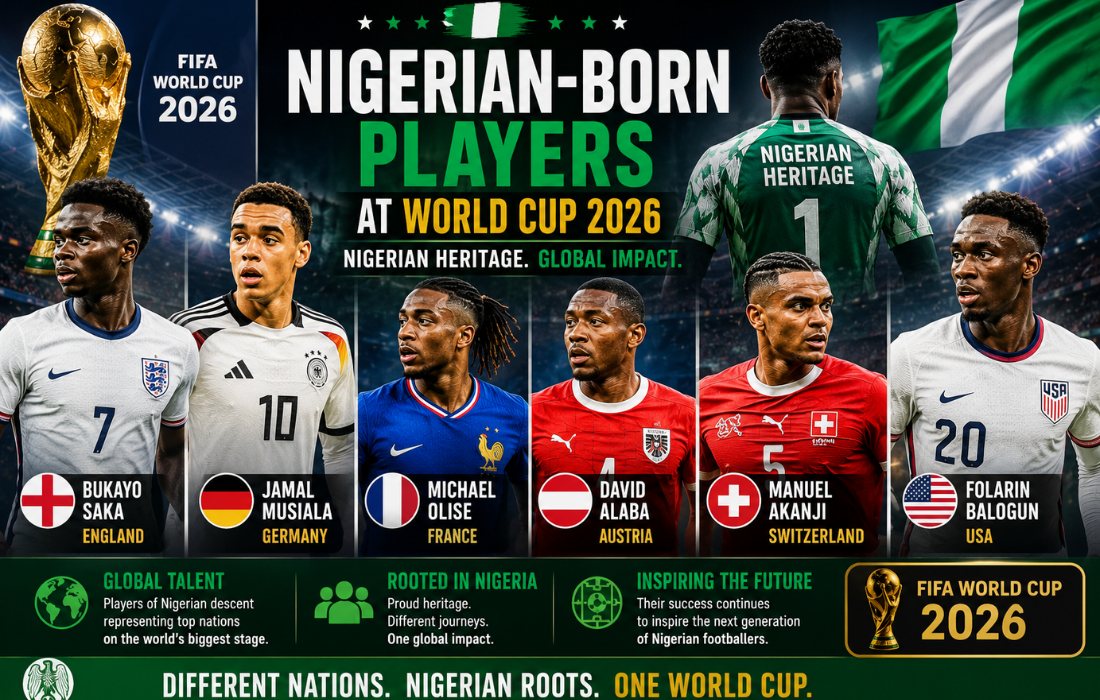
Nigeria may not be making the cut for the FIFA World Cup 2026, but that doesn’t mean Nigerian football will go unnoticed for the entire tournament.
Across Europe, North America and the rest of the footballing nations, players with Nigerian roots have become a force to be reckoned with. Lots of them were born outside Nigeria to Nigerian parents; others spent time in Nigeria as kids before ending up in foreign football academies.
As a result, World Cup 2026 is going to feature a bunch of players with Nigerian blood playing for countries like England, Germany, France, Switzerland, Austria and the US.
Their presence is a testament to how Nigerian football talent is making waves all over the world and just how a big part of the African football culture is still making its mark on the global game.
Why Nigeria Will Still Have a Presence at World Cup 2026
Although the Super Eagles did not qualify for the tournament, Nigerian football remains strongly represented through the global diaspora.
Lots of top-notch footballers born eligible for Nigeria have spent their careers in countries with big Nigerian diaspora populations. At the end of the day, some of these guys ended up choosing to play for their country of birth, while others just worked their way up through the youth ranks in another country.
Still, it means Nigerian fans are going to get to see some of their favourite players – with strong roots back in Nigeria – competing in the biggest games of the tournament.
In many ways, World Cup 2026 will showcase the worldwide impact of Nigerian football development and family heritage.
How Many Players of Nigerian Descent Are Playing at World Cup 2026?
As we stand right now, the exact number of players with Nigerian connections that’ll be featuring at the tournament is hard to call – it’s all going to come down to the final squad selections, who gets injured, and who actually gets picked for the tournament.
These guys are playing some of the key positions too – think attacking superstars, midfield maestros, defensive leaders & experienced team captains.
And some of them are already international superstars.
Nigerian Players Representing England
England’s squad is expected to include some of the most successful footballers of Nigerian descent.
Bukayo Saka
Bukayo Saka has become one of England’s most important attacking players.
The Arsenal winger brings a potent combination of creativity, pace, intelligence and consistency to the table. He’s proven himself to be one of England’s most valuable assets, able to produce top-level performances on the biggest stage.
Saka’s got Nigerian parents, which makes him one of the highest-profile players of Nigerian heritage at the World Cup 2026.
His versatility as a player is a real asset, allowing him to influence matches just about anywhere – as a winger, attacking midfielder or wing back.
Eberechi Eze
Eberechi Eze’s journey to the top is a truly remarkable story.
After working his way through the English football system, he established himself as one of the Premier League’s most technically gifted midfielders – no mean feat.
Dribbling, close control and creativity are just a few of the qualities that make Eze such a valuable asset in England’s attacking setup.
Before committing to playing for England, Eze was eligible to represent Nigeria.
Noni Madueke
Noni Madueke is another great example of Nigerian heritage having a big impact on elite-level football.
His direct attacking style and one-on-one ability have made him a real threat to opposition defences – and a promising player for England’s forward line.
With his pace and confidence, Madueke is a player that can cause problems for any defence.
Nigerian Players Representing Germany
Germany’s squad features several players with Nigerian roots who have become important figures in European football.
Jamal Musiala
Jamal Musiala is widely regarded as one of the most talented young players in the world.
His ability to operate between defensive lines, create chances, and score goals has made him a central figure for Germany.
Many analysts view Musiala as one of the players most capable of influencing the outcome of World Cup 2026.
Musiala’s got a level of technical quality and football intelligence that puts him right up there with the best attacking midfielders on the planet.
Felix Nmecha
Felix Nmecha has developed into a reliable presence in midfield for Germany.
He’s got the physicality, passing range and tactical discipline to provide a real balance in the middle of the park, and his Nigerian heritage adds another example of the strong connection between Nigerian football talent and European national teams.
Karim Adeyemi
Karim Adeyemi remains one of Germany’s most explosive attacking players.
He’s a speed merchant with a direct approach that can change the course of a match in an instant – and his attacking profile makes him a particularly valuable asset in tournament football.
His attacking profile makes him particularly valuable in tournament football.
Nigerian Players Representing France
Michael Olise
Michael Olise has rapidly become one of Europe’s most exciting attacking talents.
Michael Olise has quickly become one of the most exciting young talents in Europe.
He’s got the vision, passing ability and set-piece quality to attract attention across the football world, and with Nigerian heritage and top-level technical skills, Olise is the modern generation of footballer – the sort that can make an impact at the very highest level.
His performances in major competitions have done a lot to strengthen France’s attacking options ahead of the World Cup 2026.
Nigerian Players Representing Austria
David Alaba
David Alaba is one of the most accomplished players of Nigerian roots – and has enjoyed an incredible career at club and international level.
He’s a player of huge leadership qualities, with a versatility that makes him capable of playing anywhere across the back four, and defensive intelligence that lets him make a difference on the biggest stages – and he’s still going strong.
His experience is going to be invaluable during the World Cup.
Nigerian Players Representing Switzerland
Manuel Akanji
Manuel Akanji has developed into one of Switzerland’s most reliable defenders.
He’s got a calm head, positional awareness and a wealth of experience at elite club level that makes him a rock-solid presence at the back – one of the most reliable defenders in the business.
Noah Okafor
Noah Okafor is a player with real pace, movement and attacking versatility.
He can play across multiple forward positions, providing Switzerland with some valuable tactical flexibility – and he’s a real threat to defences just about anywhere on the pitch.
Nigerian Players Representing the United States
Folarin Balogun
Folarin Balogun’s rise has attracted considerable attention.
Folarin Balogun has come out of nowhere to attract a lot of attention.
He’s a player with strong finishing instincts, intelligent movement, and the ability to stretch defences – and his decision to represent the United States has added another talented Nigerian player to the World Cup mix.
Balogun’s got a big part to play in the US’s World Cup ambitions, and I think a lot of people are excited to see him in action.
Why Many Players of Nigerian Heritage Represent Other Countries?
Modern football is increasingly global.
Many kids of Nigerian parents grow up in countries like England, Germany, France, Switzerland, Austria, and the United States, and they end up entering local academy systems at a young age, progressing through the youth national teams and eventually reaching the senior international level.
Their decisions are influenced by multiple factors:
- Country of birth
- Family circumstances
- Football development pathways
- Youth international experience
- Competitive opportunities
Each player’s situation is unique.
Could Some of These Players Have Represented Nigeria?
Well, in several cases, the answer is yes.
Many of the players we’ve looked at here were eligible to represent Nigeria through family heritage – and some even received interest from the Nigeria Football Federation before making their final international decisions.
In different circumstances, several of these players might have gone on to form one of the strongest Super Eagles squads in history. This reality has sparked a fair amount of debate among Nigeria’s football fanbase about talent identification, player recruitment, and international eligibility rules.
The Global Impact of Nigerian Football Talent
Nigeria is without a doubt one of the top football nations in the world when it comes to churning out talented players.
The country’s football culture, its ability to develop athletic talent, and the sheer passion of its fan base all contribute to a steady stream of players who end up in elite leagues across Europe and beyond.
Today, players of Nigerian heritage compete in:
- Premier League
- Bundesliga
- La Liga
- Serie A
- Ligue 1
- Major League Soccer
- UEFA Champions League
Few countries can claim such a widespread influence on the modern game.
What This Means for the Future of the Super Eagles?
Despite Nigeria’s absence from the 2026 World Cup – which is a blow for fans to swallow – the bigger picture is pretty rosy.
The fact that so many players with Nigerian roots are doing so well on the world stage shows just how deep the talent pool connected to the country is.
With established stars like Victor Osimhen, Ademola Lookman, Alex Iwobi, Calvin Bassey, Ola Aina, and Wilfred Ndidi already making waves, a whole new generation of players is beginning to emerge.
If Nigeria can sort out its domestic talent development, strengthen the youth pathway, and improve player recruitment, then the Super Eagles should be in line to return to future World Cups as one of Africa’s top teams.
The 2026 World Cup might not have Nigeria as a participating nation, but Nigerian football talent will undoubtedly still be out there in force – with the likes of Bukayo Saka and Jamal Musiala through to Michael Olise and Folarin Balogun all showing the global reach of Nigerian football by doing their thing on the biggest stage.